What does it cost to run an EV charging network?
September 14, 2026
Read time: 12 minutes
Author: Fanny Heimonen
Quick answer
The cost to run an EV charging network falls into three parts:
- Grid connection, hardware and installation
- Platform licensing
- Operations (fixed costs, excluding electricity)
The first two are modeled carefully in almost every business case. The third is the one most operators underestimate, because it behaves differently. Grid and hardware costs are one-off and license cost is predictable. Fixed operational cost scales with the number of charge points, while revenue scales with utilization and with how many sessions actually succeed. That work includes fault triage, firmware and configuration management, driver support, hardware vendor coordination, and reporting. For a growing network it typically becomes a full-time role well before anyone budgets for one. Operators reduce it in three ways: building more automation in-house, hiring, or moving the work to a managed service provider.
We spent three days at icnc26 in Berlin in September 2026, talking to charge point operators, energy companies, hardware manufacturers and consultants. Around 10,000 people were there.
In almost every discussion, we ended up talking about costs. Grid, hardware and license costs are already well understood. What kept coming up was the part of the cost to run an EV charging network that nobody models: keeping it running once it exists, and how it grows with every charger you add.
The cost to run an EV charging network, versus the cost to build it
Most charging business cases model two lines: capital cost for grid, hardware and installation, and a per-charger or per-session platform fee. Both are predictable, and both are straightforward to defend internally.
Grid connection sits in that first line and is the one most likely to surprise you. The connection charge is sometimes the largest number in the project.
There is also a recurring part. Most European tariffs bill for the capacity you reserve rather than the energy you sell, so a site pays for its headroom whether or not the cars turn up. Dynamic load management is how operators serve more chargers from a smaller connection.
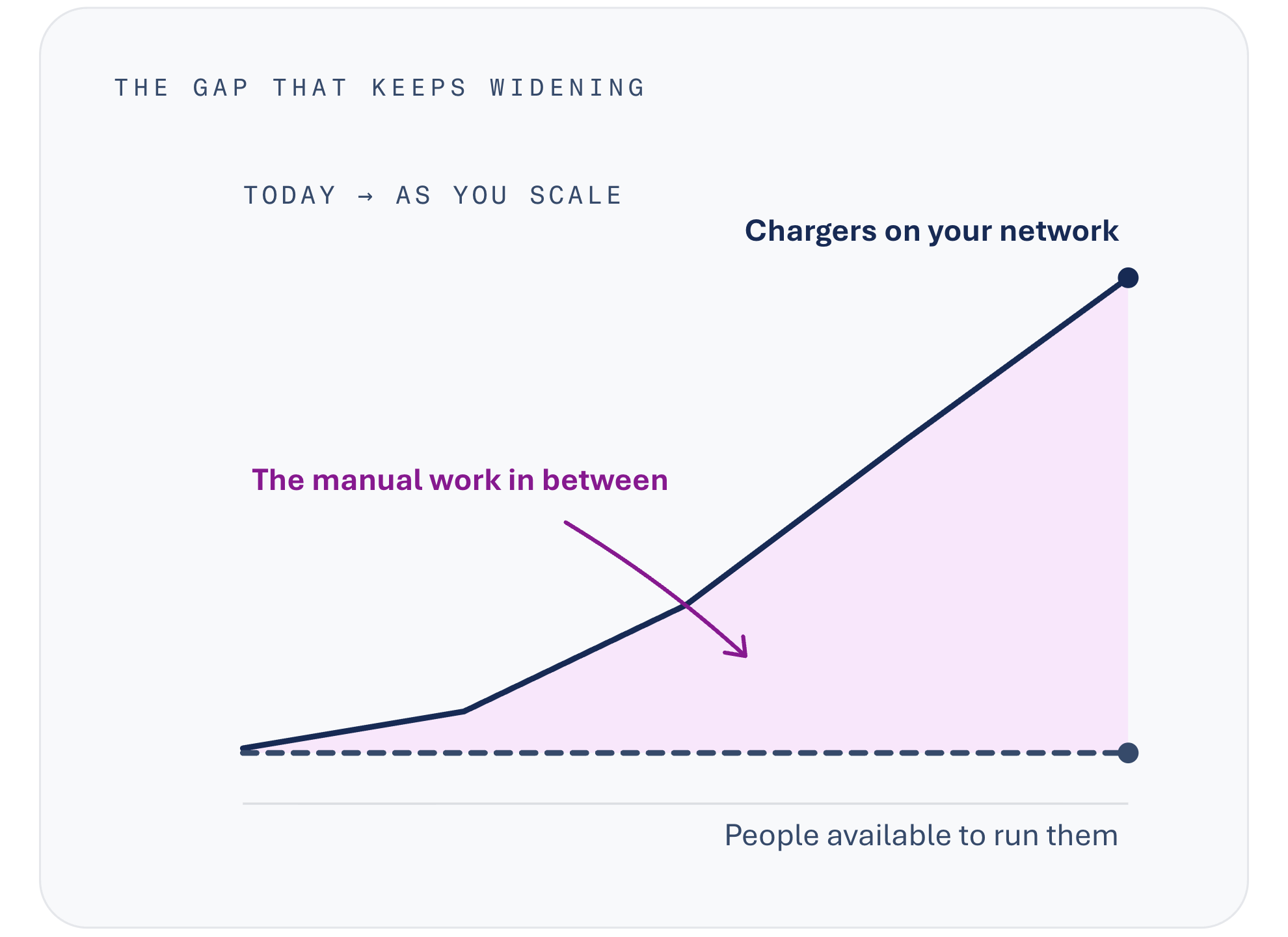
Fixed operational cost, excluding electricity, is the third line, and it follows a different rule.
- It scales with charger count, not revenue. Every charge point you add generates alarms to triage, firmware that needs pushing, configuration that drifts, and drivers who occasionally cannot start a session. Add a hundred chargers and the work goes up, whether or not those chargers are busy.
- Revenue scales with utilization, which is a different number entirely, and often lower than the business case assumed.
Those two lines pull apart as a network grows. The gap gets filled by people, and it is usually the same two or three people who were already busy.
What operational work actually consists of
Fault triage. A charger reports an error. Someone reboots it remotely, which often settles it. If it does not, they check the configuration and firmware version, then decide whether a technician needs to go out. Most of these are individually trivial but collectively substantial.
Firmware and configuration. Updates go out across the fleet, but some units do not take them. Someone has to notice which, and retry. Configuration also drifts over time, especially across mixed hardware.
Driver support. A session will not start or will not stop, or the cable will not release. These arrive whenever drivers are charging, which includes evenings and weekends.
Hardware vendor coordination. Some faults belong to the manufacturer, and getting them fixed means producing evidence they will accept. A weak report just bounces back to you.
Reporting. Uptime, availability and session success rates. Your own management wants them, site owners ask for them, and compliance increasingly requires them.
None of it is hard. It is just relentless, which is why it came up in almost every conversation we had in Berlin.
What charge point operators told us at icnc26
Four themes came up repeatedly during the event.
1. Cost per session has to fall as volume grows
Almost everyone raised costs, and it was the same version of the concern each time. As session volumes grow, cost per session needs to fall rather than climb alongside it.
What surprised us was who was raising it. It was not only the people whose job it is to negotiate contracts, but operations leads, product people and engineers, all of whom had run the numbers themselves and arrived at the same worry.
"Only a few of the people talking about costs were purchasers. Cost-effectiveness has become everyone's challenge, not just procurement's."
Sami Saarilahti, Regional Director, eMabler
2. Session success rates are low, and often not tracked at all
The number that surprised us most was how few operators could tell us their session success rate, and how low it was when they could. Some networks were running below 80%, and that was often treated as a given.
Expectations differ by market. In the Nordics, where EV charging is more mature, operators aim for 100% and follow the development in detail. Elsewhere the bar seemed lower, and in a lot of cases success rate was not tracked at all.
This matters more than it sounds. A failed session is lost revenue, higher operational cost, and a driver who may not come back. At an 80% success rate, one session in five is doing all three.
"What surprised me was not only the low success rates, but that they were accepted. A network running at 80% is losing a fifth of its business, and it was not top of mind. It should be. It is the one number that tells you whether the network is doing its job."
Juha Stenberg, CEO, eMabler
3. Automated fault resolution has moved from optional to expected
A few years ago, self-healing was a roadmap slide. This year people asked about it directly and wanted specifics: which faults can be resolved without a human, what happens to the rest, and what proof exists. There were companies at icnc26 built entirely around this one problem.
The wider AI question followed the same shape. It was rarely whether a platform has AI. It was where it genuinely helps, what work it takes off a team, and what it still cannot do. Operations is where people expect the answer to be concrete, because that is where the cost sits.
This is the layer Pulse handles on the eMabler platform: detecting charge point errors, cross-referencing manufacturer documentation, and acting automatically where it can.
4. Operators want to own the customer-facing layer
A consistent pattern in our conversations was operators wanting to build their own driver-facing interfaces on top of a core platform, rather than taking a vendor's standard app. A standard app may not fit your customers' specific needs, and it offers no differentiation from the competitor down the road running the same one. For operators whose charging sits alongside an existing business, in fuel, parking or retail, the app is also where charging connects to everything else they sell. The charging experience is part of their brand, and increasingly they treat it that way.
ABC built charging directly into its own mobile app. Aimo Park unified parking and charging across vendors, so a driver books a space and charges without meeting a second brand. Neste integrated EV charging into the whole customer journey, across individual drivers and B2B.
This has a cost consequence people underestimate. Owning your front end means you own the driver experience, and every support conversation that comes with it. So the question becomes who handles that work, and there are three answers.
Reducing operational cost: build, hire, or outsource
Charge point operators reduce operational cost in one of three ways, each with different trade-offs.
Building a CPMS in-house
The most interesting thing we heard at icnc26 came from consultants working with operators. A number of teams are now attempting to build a charge point management system in-house, and AI tools have made that look considerably more achievable than it did two years ago. To be fair, it partly is. Getting to something that works is genuinely faster now.
What those business cases tend to miss is everything that comes after.
"A lot of teams are testing whether they can build a CPMS in-house with AI. What I did not hear many factor in was the cost of maintaining it afterwards."
Juha Stenberg, CEO, eMabler
A charging platform is never finished. OCPP has versions, and manufacturers interpret them differently. Hardware vendors ship firmware that quietly changes behavior. Roaming protocols evolve. Payment rules and regulation move. None of this arrives as a project you can plan for. It arrives continuously, and it needs people who understand it.
AI has made the first version cheaper to build. It has not done much about the tenth year of running it.
There is a strategic point underneath the cost one. A CPMS is the heart of the operation and it has to work reliably, around the clock, for years. That reliability is expensive to build and to keep, and it is not where operators differentiate from each other.
What distinguishes you is the customer-facing layer above it: the features your customers actually use, the journeys you design, the portals you give B2B accounts, the insights you get from your own data. Engineering effort spent there compounds. Engineering effort spent on OCPP version handling keeps you level with everyone else.
The same question applies to running the platform, not just building it.
Hiring
Hiring is the straightforward answer, and the right one for some operators. It gets harder when:
- You need out-of-hours cover. One person cannot cover nights, weekends, holidays and sick leave, so you are hiring two or three rather than one.
- The network is growing. The work scales with charger count. Whatever you hire for now, the workload may have outgrown it in a year.
- You try to find them. Someone who understands OCPP, mixed hardware behavior and charging operations is a narrow profile, and every other operator is hiring from the same pool.
The question worth asking is whether operations is where your competitive advantage sits. Nobody wins customers by being the best in the world at rebooting a charger.
"Automation does the routine work at scale, but it does not maintain itself. Rules have to be built, tuned and kept current as chargers, firmware and fault patterns change. That work needs people who know both charging and automation, and they are hard to find and slow to hire."
Päivi Linteri, Senior Business Developer, eMabler
Outsourcing charge point operations
The third option is handing the operational work to someone who already does it at scale. It only makes financial sense when automation covers most of the routine faults, so ask how much is actually automated rather than how large the team is.
Then check the scope carefully: what exactly moves, what stays with your team, what the response commitments are, and what happens to the driver relationship.
How eMabler answers those questions
We have spent this year building eMabler Managed Services, so those are the questions we have been answering.
Our team takes on the daily running of a customer's network:
- Monitoring around the clock, on any OCPP hardware
- Faults resolved automatically where they can be
- Firmware and configuration handled across the fleet
- Monthly reporting against agreed targets, including session success rate
What stays yours is your pricing, sites, data and driver relationships.
Across our platform, session success rate averages 95.7% this year, and the work around the topic has let us raise it during 2026. Variation is still high: our best customers reach 99%, and some struggle to stay above 90%. The causes differ, and the platform is only one of them. Hardware choices, configuration, connectivity, the front end, payment and the wider IT architecture all play a part. It does not stay high on its own, which is a large part of what Managed Services is for.
Managed Services runs on the eMabler platform, with 100,000+ connected charge points across Europe, handling 1,000,000+ charging sessions a month at 99.999% uptime.
Before it becomes a headcount conversation
Grid, hardware and license costs are visible, so they get modeled. Operational cost is invisible until you are living it, and it is the one that grows with every charge point you add.
It is easier to put a number on it now than to explain later why the team needs to grow.
If that is a live question for your network, we would be glad to talk it through.
Frequently asked questions
Q: How much does it cost to run an EV charging network?
A: It varies by network size, hardware mix and public versus private sites. A useful approach is to estimate operational hours per month per hundred chargers based on your own ticket history, then multiply that by a loaded salary rate including out-of-hours cover.
Q: Does operational cost fall as a network grows?
A: Per charger, somewhat, through automation and standardization. In absolute terms it rises. The common mistake is assuming the per-charger improvement is large enough to keep total operational headcount flat.
Q: What is the difference between platform cost and operational cost?
A: Platform cost is what you pay a vendor for the software. Operational cost is what you pay your own people to use it. Two charge point operators on the same platform can have very different operational costs depending on hardware mix, site types and how much they automate.
Q: Can charging operations be outsourced entirely?
A: The operational layer can. Commercial decisions such as pricing, site selection and the driver relationship generally should not be, since those are usually where an operator's advantage sits.
Q: How does hardware choice affect operational cost?
A: Considerably. Mixed estates cost more to run than uniform ones, because failure modes and firmware behavior differ by manufacturer. This is a real trade-off against the flexibility of buying hardware-agnostic.
Q: How many people do you need to run an EV charging network?
A: There is no fixed ratio, because it depends on hardware mix, how much is automated, and whether you need cover outside office hours. A network needing 24/7 response cannot be covered by one person once holidays and sick leave are counted, so the first real threshold is two or three people rather than one. Beyond that, the work scales with charger count rather than with revenue.
Q: What is a good EV charging session success rate?
A: There is no agreed standard, which is part of the problem. Mature Nordic networks tend to aim for above 95%, while expectations elsewhere in Europe are often lower. Definitions vary too: whether a driver who unplugs by choice counts as a failure changes the number by several points. The more useful question is whether you are measuring it at all.
Q: What is included in EV charging managed services?
A: Scope varies by provider, which is why it is worth agreeing in writing. Most include monitoring, fault detection and remote resolution, firmware and configuration management, and reporting against agreed targets. First-line driver support is often excluded, and is the most commonly assumed inclusion. Pricing, site selection, tariffs and the driver relationship normally stay with the operator.
Q: Does grid connection cost count as an operational cost?
A: Partly. The connection charge is one-off and belongs with hardware and installation. But most European tariffs also bill for the capacity you reserve rather than the energy you sell, so a site pays a monthly charge based on the power it has contracted for, whether or not the chargers are busy. That part recurs, and it is sized by what you built, not by what you sold.