EV charging platform comparison: eMabler, AMPECO, Monta, Driivz and chargecloud
November 25, 2026
Updated: November 25, 2026
Read time: 12 minutes
Author: Fanny Heimonen
Quick Answer
Choosing the best EV charging platform depends on your strategy. Monta sells an end-to-end platform that includes the driver app. AMPECO, Driivz and chargecloud sell white-label platforms, a finished app and operator portal under your brand. eMabler sells an open platform, where every function is available through an API and charging plugs into the systems you already own. If EV charging is your only business, an end-to-end platform gives you the most finished product. If charging extends a business you already run, what matters is how well it connects to everything else you own. The platforms also differ in what they tell you before a sales call. Some publish their pricing, uptime figures and API documentation. Others make you ask. The comparison below works through what each type asks you to hand over, what the pricing does at volume, and what you can check for yourself before a call.
Most platform comparisons turn into a product feature checklist. That's the least useful way to choose, because standards, regulation, and competition push every CPMS toward the same feature set. Every platform in this comparison starts EV charging sessions, applies tariffs and produces charging reports.
The differences are elsewhere: in the commercial terms, how open the platform is, and how much each vendor publishes. So we compared the vendors on six themes where they genuinely differ.
- Platform types, and what each asks you to hand over
- Pricing model, and what happens as your volume grows
- Reliability, support, and who carries the cost when a session fails
- API access, MCP, and whether charging fits your systems or you fit theirs
- Product range, from charger to energy management
- Security, compliance, and where your data sits
The tables that follow are built from each vendor's public pages, checked in November 2026. Where a cell says "Not published", it means we couldn't find it published, not that the vendor doesn't do it.
Platform types, and what each asks you to hand over
EV charging platforms usually fit one of three types. Which one suits you depends more on what you already own than on what these vendors sell. Some get you running faster, others keep you more in control, but rarely do they do both. That trade runs through every row of the table below.
If the EV charging management platform category itself is new, start with what is a CSMS or CPMS.
| End-to-end platform | White-label platform | Open platform | |
|---|---|---|---|
| Examples | Monta, ChargePoint, Virta, GreenFlux | AMPECO, Driivz, chargecloud, Last Mile Solutions | eMabler, Evesto |
| What you get | The full set of charging functions, with an operator portal and the vendor's driver app | The full set of charging functions, with an operator portal and driver app under your brand | The full set of charging functions, with an operator portal and APIs connecting to the systems you already own |
| What you build | Very little, you configure the vendor's product inside their commercial model | Your brand, your pricing and your offer, inside the app the vendor built | The driver and operator experience you run |
| What you trade | The driver relationship, and often who collects the driver's payment | Control of the experience, so you can only offer what the app already does | Engineering resources to build and run your own front end |
| Who owns the customer relationship | Often the vendor, under their brand | Yours in name, inside an app the vendor builds and controls | Yours, inside systems you already own |
Vendors can move between these categories as their products change.
If the customer relationship lives in your existing systems, like an app, loyalty program, or billing system, the end-to-end column asks you to hand that over. If it doesn't, the same column saves you years of work.
Starting quickly with an end-to-end platform is appealing, and for plenty of operators it is the right call. The speed comes from decisions the vendor has already made and features they've already built, so your roadmap is tied to theirs.
You also need to consider switching costs. If your drivers hold the vendor's app, changing platforms means asking every one of them to download a new app and enter their payment details again, which is a likely churn event. A white-label app carries your branding but is still the vendor's software, so you lose it when the contract ends, and your drivers face the same re-registration ask. If you build the front end yourself, it stays yours whatever happens to the contract, and changing the platform behind it is invisible to the driver.
When the end-user app belongs to the vendor, the driver can end up holding an account with them rather than with you, and the vendor can market to that driver afterwards without you seeing it. Ask whose name is on the receipt and who is allowed to contact the driver. Open platform vendors don't run driver apps or charging networks, so the driver and the data stay yours.
ABC sits in the open column, and their IT lead puts the reasoning plainly.
"Rather than a simple provider, we were looking for a partner who wouldn't just hand over a fixed, end-to-end solution. We needed something that could evolve with our use cases and adapt as our requirements changed." - Erno Ratia, Head of IT at ABC
Building the front end yourself also means defining it yourself. What the service does for drivers, what it charges for, and what gets added next become your decisions rather than the vendor's. That is an advantage if you want to be the one making the calls.
Moving the estate is a separate job from building the front end, and it doesn't have to be slow. Time Park migrated their network to eMabler in 14 days. ABC moved 2,700+ chargers at 380+ sites, and their tech lead Antti Välijärvi described it as the "smoothest migration" he's ever been involved in.
The sections that follow compare five of these platforms rather than every one on the market. Monta, AMPECO and eMabler each lead one of the three groups above, chargecloud is well established in central Europe, and Driivz brings in a vendor that is not European-owned. Between them they cover the range of platforms an operator would realistically evaluate.
Pricing model, and what happens as your volume grows
Three of the five platforms won't tell you what they charge until you have sat through a demo. That is the first difference to notice, because it decides how much of your evaluation happens inside a sales process rather than on your own terms.
The rest of the table shows what each vendor's revenue is tied to. Some take a share of what your drivers pay, others charge for every charge point you connect. That decides what your bill looks like in three years, so it matters more than which monthly plan looks cheapest today.
| eMabler | AMPECO | Driivz | Monta | chargecloud | |
|---|---|---|---|---|---|
| Prices published | Yes | No | No | Yes | No |
| Pricing model | Flat monthly plan plus a usage-based fee | Not published | Not published | Platform, per-socket, and transaction fee | Not published |
| Takes a share of your charging revenue | No | Not published | Not published | Yes, 2 to 5% | Not published |
| Per-socket fee | No, unlimited on every plan | Not published | Not published | Yes, priced per socket | Not published |
Two things in that table compound. A share of your charging revenue rises with your prices as well as your volume, so the vendor earns more when energy costs rise and more again when you raise your tariffs, without doing anything extra. A per-socket fee rises with every charger you connect, whether or not anyone uses it. A usage fee, by contrast, rises with activity alone. Whichever model you are weighing, run the numbers at three times today's volume.
You can see our pricing without any commitments, and we have broken down what it costs to run a charging network beyond the platform fee.
"eMabler's business model is more aligned with how we do business and how we structure charging. The modularity fits us particularly well because we are in an expansion phase. As we grow, we can add new capabilities within eMabler as our needs evolve." - Henrik Fauske, Product Owner at Time Park · Read the Time Park success story
Reliability, support, and who carries the cost when a session fails
Reliability is revenue. When charging works, drivers finish their session, pay, and come back. When it doesn't, you lose the session and maybe the driver, and the complaint lands on whoever's brand is on the site.
Reliability can be measured in several ways. Platform uptime is perhaps the most common one. It's the share of time the platform was available, which sounds simple until you ask what a vendor counts. Some report on a single service, others on a dozen or more, and scheduled maintenance might or might not be included. The figures are self-reported rather than independently audited, so two vendors quoting the same number may not be describing the same thing.
Beyond uptime, look at the service level agreement (SLA): what it warrants, and whether the vendor reports against it. A customer satisfaction or Net Promoter Score (NPS) goes further, showing what customers experienced rather than what the vendor committed to.
| eMabler | AMPECO | Driivz | Monta | chargecloud | |
|---|---|---|---|---|---|
| Public status page | Yes, 90-day history | No | No | Yes, 90-day history | Yes, history back to 2025 |
| Platform uptime last 90 days | 100% | Not published | Not published | 99.94% | Not published |
| Published SLA tiers | Bronze, Silver, Gold, Platinum | No | No | Standard, Gold, Platinum | No |
| Published SLA compliance | Yes, 100% | No | No | No | No |
| Customer satisfaction | 4.9 / 5 | Not published | Not published | Not published | Not published |
Three of the five run a public status page, covering different components, with historical views and an incident log you can subscribe to. Past that, the columns are mostly empty.
The measure operators actually live with is in none of the columns, because almost nobody publishes it. Success rate is the share of charging attempts that lead to a started session. It matters because a platform can report excellent uptime while a significant share of those attempts never deliver power. We publish how we measure success rate, including the definition.
Uptime and success rates don't only depend on the platform. Hardware choice, configuration, connectivity, the front end, payment, and the wider IT architecture all play a part.
"Charging quality is the elephant in the room, and most of the industry would rather not talk about it. The gap between a good success rate and a poor one is tens of thousands of euros in lost revenue every month, unhappy drivers and extra operating cost." - Juha Stenberg, CEO and co-founder at eMabler
Who carries the cost of a failed session depends on how the vendor is paid. A vendor paid per socket or per month earns the same whether your chargers work or not, so a failed session is your problem alone. Our pricing has two parts: a flat monthly plan you pay either way, and a usage fee that only applies when your chargers actually deliver. A failed session earns us nothing beyond the plan.
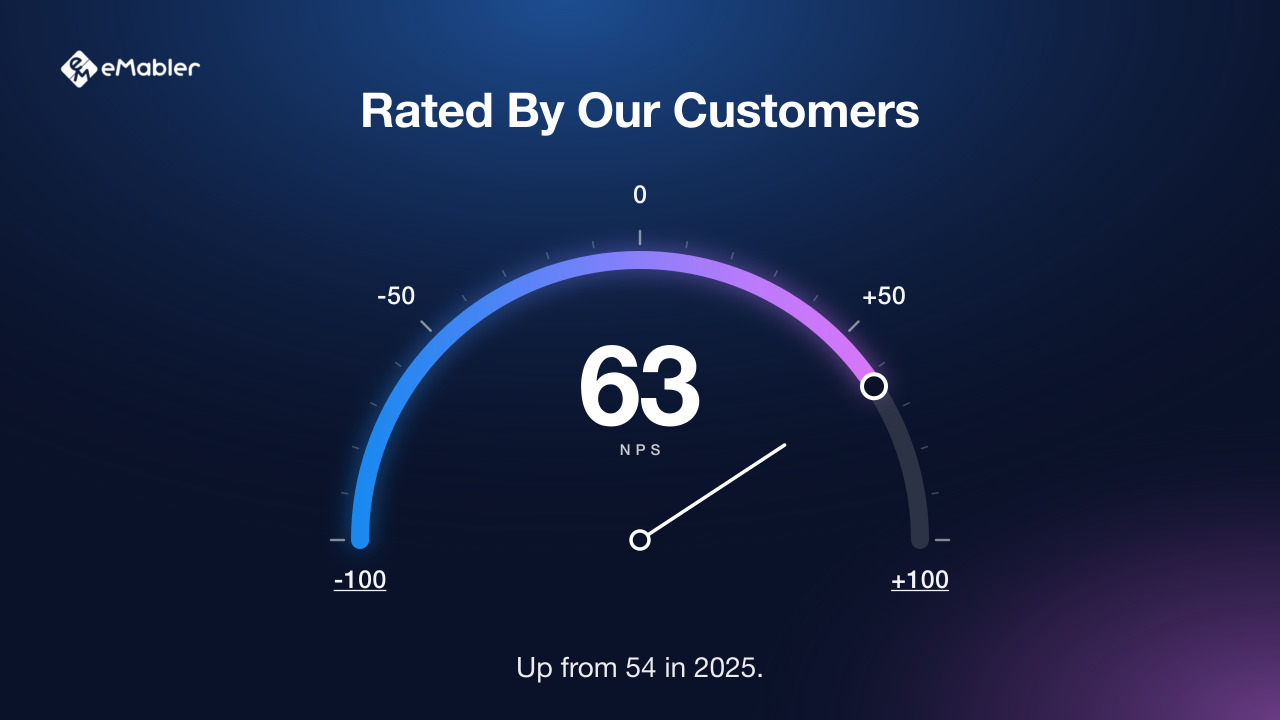
Support is part of reliability, and the hardest thing to compare from a website. An SLA tier promises a response time, not a fix. The question worth asking every vendor is how many people sit between you and someone who can change the code. With us, none: you reach our engineers directly, and they work through the problem with you. That is why we publish what customers think of our support: a 4.9 out of 5 satisfaction score, and an NPS of 63 on a scale from -100 to +100.
So check the uptime figures, success rates, status pages and maintenance histories, and ask any vendor, us included, what those figures include and exclude. The answers may vary more than you would expect.
API access, MCP, and whether charging fits your systems or you fit theirs
Every vendor now says they are API-first, so the words have stopped telling you anything. What tells you something is whether you can open their API documentation yourself and read it without booking a demo.
API access and openness decide whether charging fits into the business you already run, or whether your business must reorganize around a charging product line. The practical test is what happens when you need something the vendor hasn't built: with a complete API you build it yourself this quarter, without one you join the vendor's roadmap queue.
The table below shows what you can read without asking, what the API can actually do, how events reach you, and what the API speaks.
| eMabler | AMPECO | Driivz | Monta | chargecloud | |
|---|---|---|---|---|---|
| Public API docs | Yes | Yes | No, requires a login | Yes, but Partner API needs a commercial agreement | No |
| Public API changelog | Yes | Yes | No | Yes | No |
| Full product available via API | 100% | 90%, exclusions not listed | Not published | Not published | Not published |
| MCP server for AI agents | Yes | Yes | Not published | Yes | Not published |
| Push delivery targets | Webhook, Kafka, Azure Service Bus, AWS SNS | Webhook and Kafka | Not published | Webhook, signed payloads | Not published |
| Real-time session authorization | Yes | Outbound notification only | Not published | Not published | Not published |
| Public hardware compatibility list | Yes, 200+ models | Yes, but no total count | No list, 2,500+ models claimed | Yes, 960 models | Yes, 187 models |
| OCPP versions published | 1.6J, plus 2.0.1 on listed models | 1.5, 1.6J, 2.0.1 | 1.6J and 2.0.1, OCA certified | 1.6J, 2.0.1 | 1.5, 1.6J, 2.0.1 claimed |
| OCPI versions published | 2.1.1, 2.2, 2.2.1 | 2.1.1, 2.2 | 2.2.1 | 2.1.1, 2.2.1 | Not published |
| API rate limits | No fixed public limit, set with you during onboarding | 1,000 per minute, 100,000 per 24 hours | Not published | 10 per minute public, 1,000 per 10 minutes for partners | Not published |
Four rows in that table are worth your attention, because they're the ones your engineers will run into when they build the integration.
- Full product available via API: A stated 90% coverage of back-office functions sounds high, but with no list of the missing 10% you only find out which functions are absent once you are building. Ask for the list before you sign.
- Push delivery targets: Push targets decide how much infrastructure you end up running yourself. A webhook means your team builds and operates an always-on endpoint, while a platform that speaks Azure Service Bus or AWS SNS delivers into infrastructure you already have.
- Real-time session authorization: This means your own system decides, before a session starts, whether this driver can charge and at what price. Without it, the platform decides, and you will find out afterwards.
- Public hardware compatibility list: The counts are not like for like. Each vendor decides what counts as a model, and whether firmware builds, connector options and regional versions get their own entry. A bigger number can mean broader support or just finer slicing. What matters is whether you can look up your own chargers on the list, not whose total is highest.
One row in that table is newer than the rest. An MCP server connects your AI agents to your charging data, so you have all context in one place. Questions like "which chargers failed last night" become a discussion with your AI Agent, like Claude, rather than a report someone has to build.
We're an open platform in a specific sense: the product is built on the same APIs we give you, so the API does everything the product does, with 300+ ready integrations behind it. You can test that claim. Pick any action in the product and ask us for the endpoint.
"eMabler's APIs are well designed and clearly documented, which made the integration straightforward for our team. The platform is technically robust and gives us confidence as we scale our charging operations." - Olga Pieritz, Head of Charging at Parcandi · Read the Parcandi success story
Product range, from charger to energy management
Charging rarely stays as it started. Most operators begin with charger management and reporting, then need tariffs, payments, and energy management.
All five vendors offer more or less the same products. The range only starts to matter at the edges, when charging grows into something the basics don't cover.
Those edges are where our roots show. We are Nordic, where EV adoption ran years ahead of most of Europe, so our early customers hit scale, grid and billing problems other markets are meeting now. That shows up in what our platform is designed around. We're built API-first from day one, rather than an API focus added over the product later, so every function and all of your data are available to your own systems.
Enico is what that looks like in practice. Enforcing the energy strategy at charger level halved their capacity charges from €96k to €48k, avoided about €120k of grid reinforcement, and opened roughly €150k a year in market revenue.
Where the other four vendors are strong on this theme comes back to the driver app. Monta ships an end-to-end suite including an end-user app we don't build. AMPECO, Driivz and chargecloud all ship a finished white-label app and operator portal under your brand. We have an operator portal too, but we don't hand you a finished driver app to put your name on. If you want an end-to-end charging product rather than charging capability, that's a real advantage and it's theirs.
Security, compliance, and where your data sits
Security reviews are starting earlier and involving more than procurement and legal. The questions involve how security is managed, which compliance frameworks a vendor follows, where it is based and where the data sits.
ISO 27001 is the international standard for information security management. The other ISO numbers in the table are extensions audited on top of a 27001 certificate, each covering a specific area such as cloud services or privacy.
Ownership matters as much as headquarters, and public and utility tenders increasingly ask about it directly. Check where your data is processed, who can require access to it, and whose law the parent company answers to. The table below shows a US-listed parent behind Driivz and part-US ownership behind Monta.
| eMabler | AMPECO | Driivz | Monta | chargecloud | |
|---|---|---|---|---|---|
| Security certification | ISO 27001 | ISO/IEC 27001:2022, ISO/IEC 27017:2015, ISO/IEC 27018:2019, ISO/IEC 27701:2019, SOC 2 Type II | ISO 27001, CyberVadis platinum | ISO/IEC 27001:2022, SOC 2 Type II | ISO 27001, ISO 9001, ISO 14001, BSI C5 (data centres) |
| Recorded security breaches | 0 | Not published | Not published | Not published | Not published |
| Compliance frameworks published | GDPR, AFIR, PCI DSS, EU Data Act, ISO 15118, Plug & Charge | GDPR, NIS2, PSD2, ISO 15118, Plug & Charge | GDPR, PCI-SAQ, ISO 15118, Plug & Charge | GDPR, PCI DSS, NIS2, Plug & Charge | GDPR |
| Headquarters | Finland | Bulgaria | United States | Denmark | Germany |
| Ownership | European | European | US, NYSE listed | European and US | European |
We hold ISO 27001. Two of the five also publish SOC 2 Type II, a US standard where a licensed CPA firm tests a vendor's controls over a period and publishes its opinion. Our Information Security Management System (ISMS), which ISO 27001 certifies, covers most of the same ground, including availability and confidentiality, access control, change management, incident response, vendor management and risk assessment. If your security review calls for a SOC 2 report specifically, raise it with us early and we will tell you exactly what we can provide.
What to ask every vendor, including us
The six themes above tell you what to compare. These are the questions that get you the answers.
- Whose customer is the driver, and do they come with me if I change platform? A good answer names which brand appears on the driver's account and on the receipt, and says what happens to that account when the contract ends.
- Can my engineers read the API docs and my finance lead see a price, without booking a call? A good answer is a URL. Ask about a sandbox in the same breath.
- What does the revenue share cost at three times today's volume? Run it on your own forecast, not on the vendor's example.
- Who owns the OCPP and session data? Ask which clause of the contract says so. Check whether the vendor claims rights in data the platform generates, not only data you upload.
- What is the notice period, and how do I actually leave? Check the termination, price escalation and data clauses first.
- What does your uptime figure exclude, and what happened in the last twelve months of maintenance windows? The second half is the one almost nobody asks.
- What is your success rate, and how do you calculate it? Almost nobody publishes one, so expect to have to ask.
Those seven are the ones that change a shortlist. For more questions to take into a vendor call, see questions to ask a vendor before you sign.
If you are moving off an existing platform, our EV charging platform migration guide covers the mechanics and the timeline.
Looking for a Monta, AMPECO or Driivz alternative?
Most people reading a page like this are already running on a platform and testing whether the alternatives are better.
Monta vs. eMabler
If you are looking for a Monta alternative, price the revenue share first. Monta's published EU pricing takes 2 to 5% of transaction revenue plus 8% on roaming, so which one costs less depends on your volume forecast, not on the feature list. We charge a flat monthly plan plus a usage fee and take no share of your revenue. Monta also runs its own driver app and charging network, and we run neither, so the driver relationship stays yours.
AMPECO vs. eMabler
If you are looking for an AMPECO alternative, the question is whether you want the charging product built for you or built and owned by you. AMPECO ships a white-label app and operator portal, which is the faster route to a branded service. An open platform puts the same functions behind APIs, asks for engineering resources, but lets you keep control: of the data, customer relationship and roadmap.
Driivz vs. eMabler
If you are looking for a Driivz alternative, the trade is scale against transparency. Driivz is owned by NYSE-listed Vontier, which puts a large public company behind the platform. It publishes very little you can check yourself, though: no prices, no public developer portal, no uptime figure and no SLA terms, so most of what you want to know comes out only in a sales conversation.
Where we are the wrong choice
An open platform asks you to build your own front end, which means deciding what charging looks like for your customers rather than taking that decision off the shelf. If you want a finished charging product with an integrated app in the app stores, AMPECO or Monta will get you there faster.
With an end-to-end or white-label platform, the question is what it costs you to leave. Putting the whole stack with one vendor is exactly what makes changing platforms expensive three years on, and the cost isn't only commercial. The more of the stack one vendor holds, the more of your control, your data and your customer relationship sits with somebody else, and each of those is harder to take back than it was to hand over.
Our key customer segments are energy, retail and petrol companies, and parking operators, where charging is one line inside a business that already owns the customer. We run more than 1.5 million charging sessions a month at 99.999% platform uptime across 11 countries and 130,000+ connected charge points.
What to do next
Take the six themes and questions into your next vendor calls, ours included, and ask for the answers in writing.
With us, you can start without asking. See what it would cost you. No form, no demo booking. Send us your charger model list at the same time and we will check it against our public compatibility list.
If you would rather see the platform working, book a demo.
How we compiled this
Everything in the tables comes from each vendor's public pages and our own product documentation, checked in November 2026. Where a cell says "Not published", it means we couldn't find it published, not that the vendor doesn't do it. We also publish more about ourselves than we can find about anyone else, so this page is better informed about eMabler than about the other four.
Vendor pages change. If something here is out of date or wrong, tell us and we'll correct it.